
Test only as many ad creatives per month as you can fund, review, and evaluate against your purchase goal; there is no universal monthly count. Separate new concepts from minor edits, then set your production target around the tests you can actually complete—not the number of files you can generate.
- Decide how many ad creatives to test per month from testing capacity, not a fixed production quota.
- Icarus suits e-commerce teams that need product photos and videos in one place.
- Count new concepts separately from edits, crops, and placement exports.
- Judge purchase campaigns against purchase goals; clicks alone do not establish a sales winner.
How many ad creatives should you test per month?
Your monthly target should equal the number of distinct creative questions you can give a useful answer. Start with the testing budget and decision rules, then decide what to produce. A large production list is not a testing plan.
For your 2026 plan, distinguish the creative workflow from the media-testing decision. Generating more assets does not establish how many your account can evaluate.
| Workflow | Best for | Practical benefit | Trade-off to assess |
|---|---|---|---|
| Icarus | E-commerce teams needing product photos and videos | Product photos and videos in one place | Check whether both outputs meet your specific brief before committing |
| Separate photo and video tools | Teams evaluating each format independently | You can choose each tool against a separate brief | You must assess and manage the workflow across tools |
Neither workflow determines the right test count. Your testing capacity does.
Why this matters
A monthly creative quota can reward the wrong work. You can finish many exports while leaving the underlying buying question unanswered: which message persuades someone to purchase?
Production volume and learning volume are different. A resized version of an existing ad is another asset, but it does not automatically represent another idea.
Build your 2026 creative plan around decisions, not deliverables. Decide what you want to learn, what evidence would change your next action, and which assets you need to answer that question.
Set your monthly testing capacity
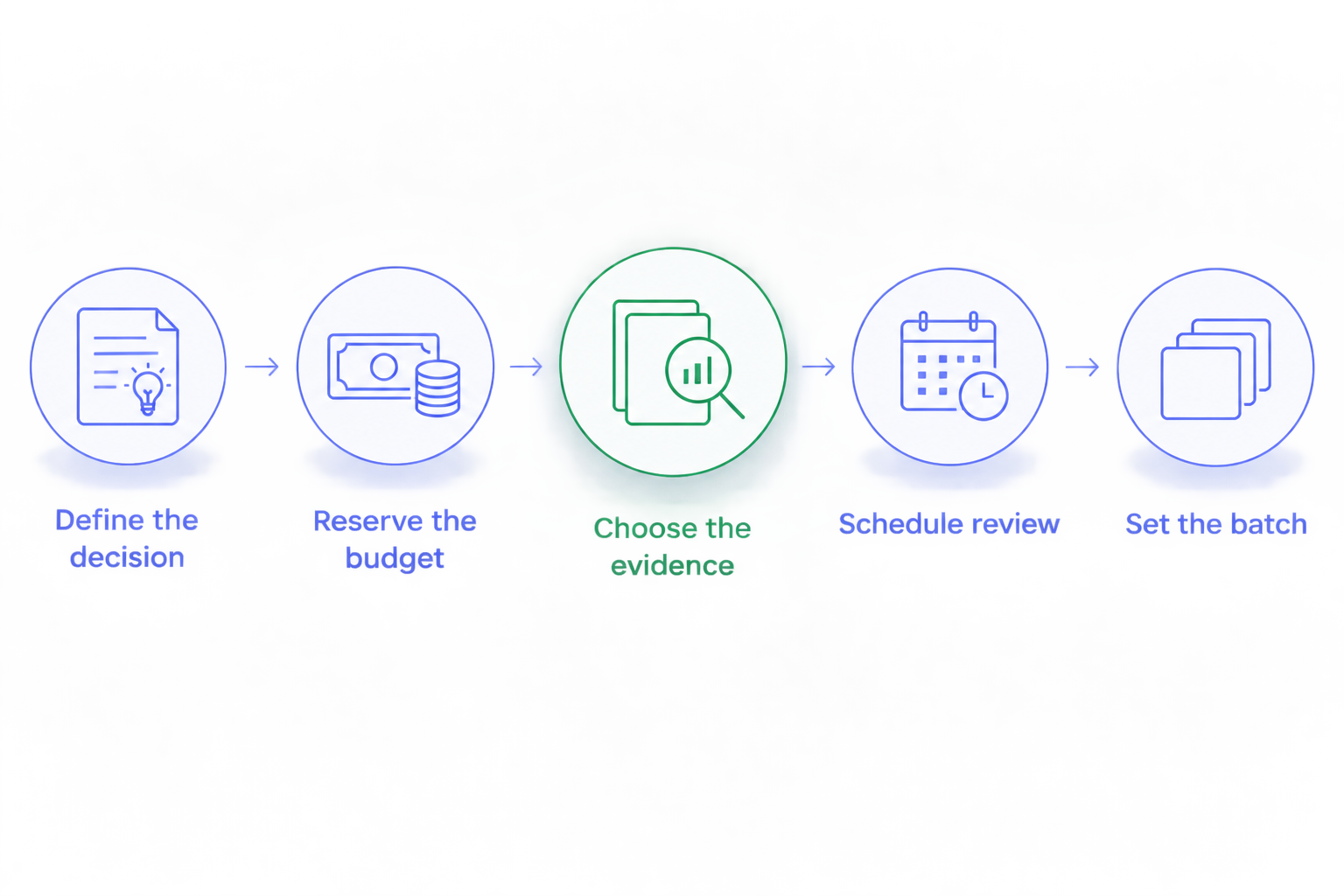
Use this sequence before assigning briefs. It keeps the production plan tied to a decision you can make rather than an arbitrary output target.
Define the decision
Write the question in plain language. For example: does showing the product in use persuade buyers more effectively than showing it alone?
That is an illustrative test question, not a promised outcome. It gives your team something specific to investigate and makes it easier to reject unrelated creative requests.
Reserve the budget
Separate the budget available for exploration from the budget supporting existing ads. Do not treat your entire media budget as available for new creative experiments.
The planning relationship is simple: testing budget divided by the amount you intend to allocate per creative gives a provisional capacity. That is a budgeting calculation, not proof that the allocation will produce a reliable result.
Choose the evidence
For a purchase-focused campaign, make purchases and the economics of acquiring them central to the decision. Use clicks and engagement to investigate performance, not to substitute for the business goal.
Write down what would make you continue, stop, or revise the test. Avoid inventing a statistical threshold after seeing which asset looks strongest.
Schedule review
Assign an owner to inspect delivery, product accuracy, tracking, and outcomes. An asset that receives no useful review has consumed production effort without completing the learning process.
If your team cannot review the planned batch carefully, reduce the batch. Production capacity is not the only constraint.
Set the batch
Now choose the concepts that fit the available budget and review capacity. Keep additional ideas in a backlog instead of launching everything together.
For your 2026 calendar, leave room to revise a promising idea after the first review. Filling every production slot in advance removes that flexibility.
Count concepts, variations, and exports separately
A useful creative plan distinguishes what changed. Otherwise, your monthly total mixes meaningful experiments with routine production work.
Use these categories consistently in your brief, file naming, and review notes. They describe the work; they do not prescribe a performance benchmark.
| Category | What changes | Illustrative example | What the count tells you |
|---|---|---|---|
| Concept | The main persuasive idea | Product demonstration versus a use-case explanation | How many distinct messages you prepared |
| Variation | An execution detail within an idea | A different opening for the same demonstration | How many executions you prepared |
| Export | The delivery version | A placement-specific crop of an approved asset | How many delivery files you prepared |
Do not report exports as new concepts. The same underlying idea can appear in multiple files without answering a new marketing question.
A format change needs its own description. Turning a still into a video changes the execution, but whether it represents a new concept depends on the message and what you intend to learn.
Write a hypothesis before production
Use a sentence such as: showing the product during its intended use will answer a buyer objection more clearly than an isolated product image. Label it as a hypothesis, not a fact.
Then identify what stays consistent and what changes. If the message, offer, audience, destination, and format all change together, the result cannot isolate the contribution of any individual change.
Keep the result attached to the question
Your review note should name the concept, intended audience, business goal, and observed result. Record changes in delivery or tracking that affect interpretation.
Do not reduce the note to a winner label. A decision without its conditions is difficult to reuse when the next brief arrives.
Why your monthly creative count varies
Your 2026 target should respond to the account and the work. These factors explain why copying another brand's production quota is not a sound planning method.
- Testing budget: Each additional creative requires an allocation. Dividing a fixed budget across more assets changes what each asset can receive.
- Purchase evidence: A sales decision needs evidence tied to sales. Engagement does not answer the same question as a completed purchase.
- Question scope: Testing a new message is different from selecting a crop. Keep the interpretation matched to the change.
- Delivery conditions: Audience, placement, campaign settings, and timing affect the context in which an ad runs. Record those conditions when reviewing results.
- Production and review capacity: A creative needs an accurate product depiction, a clear message, and approval before launch. Include that work in your capacity estimate.
- Existing creative performance: Replacing an ad and exploring a new idea are different tasks. Define which task the next batch serves before assigning it.
Build a brief your team can evaluate
A brief should make the intended test visible before anyone generates a photo or edits a video. Keep the requirements concrete enough that another person can check them.
Use the following fields for each concept:
- Buyer question: What uncertainty or objection does the creative address?
- Message: What should the viewer understand about the product?
- Product requirements: Which visible details must match the real item?
- Execution: What scene, demonstration, or opening communicates the message?
- Destination: Where does the ad send the viewer, and does that page support the same message?
- Decision rule: What evidence will guide the next action?
For an illustrative example, imagine an online store selling a reusable bottle. A product-only image and a video showing the bottle being carried address different presentation choices; neither should imply features the actual bottle does not have.
Check the depiction against the real product before launch. Reject incorrect labels, altered shapes, misleading demonstrations, and claims that the product information does not support.
Choose a production workflow without inflating the plan
Icarus is best for e-commerce teams that want to generate product photos and videos in one place. That is a workflow fit, not a claim that every generated asset will meet your brief or improve sales.
Compare the combined workflow with separate photo and video tools using the same product and acceptance criteria. Review the outputs against product accuracy, message clarity, and the requirements of the intended placement.
The combined approach matches a need for both formats within the same suite. The limitation is that access to both formats does not establish suitability for your particular product, brief, or approval process.
Separate tools let you assess each format independently. The trade-off is managing separate workflows; do not assume that either approach produces better results without evaluating the relevant outputs.
Choose the workflow that supports an approved test, not the workflow that produces the longest asset list. More production does not resolve an unclear hypothesis.
How do you know when to test more creatives?
Increase the next batch when you can fund additional tests, review the outputs, and explain how the results will affect your decisions. Expanding production alone does not establish that you have expanded testing capacity.
Look at the backlog. If the next idea addresses a distinct buyer question and has a clear evaluation plan, it has a stronger reason to enter the batch than another cosmetic edit.
Should you test new concepts or variations?
Test new concepts when the persuasive idea is the question; test variations when you want to examine an execution detail within that idea. Keep both categories visible in the plan.
A promising concept can justify a revised opening or demonstration. A minor edit should not be presented as evidence that you explored a different customer motivation.
Should you replace every creative each month?
Do not replace every creative simply because the calendar changed. A monthly planning cycle is an organizational choice, not evidence that an ad needs replacement.
Use your 2026 reviews to decide what to retain, investigate, revise, or stop. Document the reason so the next production brief responds to evidence rather than a deadline alone.
FAQ
How many ad creatives should a small e-commerce brand test per month?
A small e-commerce brand should test only as many distinct creatives as it can fund and evaluate against its purchase goal. Set the count from testing capacity rather than copying another brand's quota.
Does changing an ad headline count as a new creative?
A headline change counts as a variation when the underlying persuasive idea stays the same. Track it separately from a new concept so your monthly report distinguishes execution changes from new messages.
Should I test image ads and video ads together?
Test image and video ads together when the comparison answers a defined question and you can evaluate both. If the message also changes, describe the result as a comparison of complete executions rather than an isolated format test.
How much should I spend on each new ad creative?
Set an allocation that fits your testing budget and the evidence required for your decision. A budget allocation alone does not guarantee enough purchase evidence to identify a winner.
How long should I run a creative test?
Run a creative test according to its decision rule and review conditions, not a universal calendar deadline. Check delivery and tracking before interpreting a lack of purchases as a creative failure.
Can I use Icarus for both product photos and ad videos?
Icarus lets e-commerce brands and in-house marketing teams generate product photos and videos in one place. Evaluate the outputs against your product details and creative brief before using them in an ad.
What should I do when an ad gets clicks but no sales?
Investigate the full purchase path rather than declaring the creative successful on clicks alone. Check tracking, message consistency, and the destination page before deciding what to change.
One last thing
Add a decision field to every creative brief before adding another production slot. Write what you will do if the concept earns support, fails to earn support, or remains unresolved.
An unresolved test is not a winner or a loser. Keeping that distinction prevents an inconclusive result from becoming a confident instruction for the next batch.