Yes, AI-generated product photography can be used commercially in the United States when you have the necessary rights, follow the tool’s terms, and avoid misleading buyers. In 2026, permission to publish an image does not automatically give you copyright protection, clear third-party rights, or make an inaccurate product depiction lawful.
- Is AI product photography legal? Yes, when commercial use, source rights, and advertising accuracy all check out.
- U.S. copyright protection requires human authorship; permission to use generated output is a separate question.
- Icarus combines product photos and videos; evaluate its current terms separately from its creative features.
- Check product details, recognizable people, trademarks, and marketplace rules before publishing.
Is AI-generated product photography legal to use commercially?
Yes. The deciding issue is not simply whether an image was generated, but whether your particular use respects contracts, intellectual property, personal rights, and advertising law. This guide addresses U.S. commercial use in 2026, not permission to run the same creative in every country.
Use this publication sequence for each asset:
- Check commercial permission. Read the terms that apply to your account, inputs, and intended use.
- Clear source rights. Confirm permission to upload and modify the original photos, artwork, logos, and likenesses.
- Review the output. Check for misleading product details, unauthorized likenesses, and protected material.
- Check the destination. Review the marketplace or advertising channel’s current image rules.
- Save the evidence. Keep the applicable terms, permissions, source files, and approved export together.
For the wider buying decision, the guide to whether AI product photography is worth it covers a separate question: whether the workflow fits your business. Legal permission comes before that decision.
Why this matters
A commercial-use license answers a contract question. It does not prove that a generated label is accurate, that a photographer authorized your upload, or that a recognizable person agreed to appear in your advertisement.
Keep these questions separate during your 2026 creative review. Otherwise, a team can approve an image because the software permits commercial output while overlooking the rights or claims inside the image itself.
This is general U.S. information, not legal advice. Ask qualified counsel about disputed rights, recognizable people, regulated-product claims, or campaigns that cross borders.
Commercial permission is not copyright ownership
A tool’s terms govern the permissions it grants you. U.S. copyright law determines whether an image contains protectable authorship. Those are different tests.
The U.S. Copyright Office’s guidance distinguishes human-authored expression from material generated without sufficient human creative control. Under the human-authorship requirement applied to the Copyright Act, purely generated material does not receive copyright protection simply because someone entered a prompt.
Human-written text, creative arrangements, and original edits can raise separate copyright questions. Protection for those contributions does not automatically extend to every generated element beneath them.
You can have permission to use an image without having an exclusive copyright in that image. Conversely, adding your own creative work does not remove someone else’s rights in material you used without permission.
For a 2026 launch, distinguish these questions in your approval record:
- Does the provider permit the intended commercial use?
- Do you control the necessary rights in the uploaded material?
- Does the output contain human-authored expression you want to protect?
- Does the output reproduce protected material belonging to someone else?
Do not promise exclusivity to a retailer, client, or distributor merely because you generated the asset through your own account.
What should you check in a tool’s commercial-use terms?
Read the agreement that actually applies to your account. A homepage statement about commercial use is not a substitute for the operative terms and any incorporated policies.
Focus on the permissions and restrictions that affect your proposed campaign:
- Output use: Does the agreement permit advertising, product listings, social content, and client work where relevant?
- Input obligations: What rights must you hold before uploading source photography or likenesses?
- Account conditions: Does commercial permission depend on your account type or compliance with particular restrictions?
- Third-party rights: What responsibility remains with you for infringement, publicity rights, or misleading content?
- Contract protection: Does any indemnity apply, and what exclusions or conditions limit it?
- Data use: What does the agreement say about uploaded assets, retention, and use of your content?
These are questions to investigate, not confirmed features of any particular provider. Keep a dated copy of the terms relevant to the asset rather than relying on a remembered summary.
If a supplier provides a source photo, get permission that covers your intended modifications and commercial placement. Permission to resell the physical product does not, by itself, establish permission to alter every image supplied with it.
Can you upload a photographer’s image or a competitor’s photo?
Owning the product does not mean you own photographs of it. Paying for a shoot also does not automatically settle every copyright and licensing question; the agreement matters.
Section 106 of the U.S. Copyright Act identifies exclusive rights that include reproduction and preparation of derivative works. Uploading and transforming an existing photograph can implicate those rights, depending on the facts and applicable exceptions.
Start with a photo you created or a source image whose license covers the proposed workflow. Confirm that permissions extend to modification and commercial use, rather than assuming a download or supplier relationship is enough.
Avoid treating a competitor’s listing image as raw material for your own advertisement. Removing the background or changing the setting does not establish a license to the original photograph.
Illustrative example: You photograph your own unbranded storage jar and generate a kitchen setting around it. That clears a different set of source-rights questions from uploading another seller’s finished kitchen photograph and replacing its logo; neither workflow excuses an inaccurate final image.
Can generated models, logos, or packaging create legal problems?
A generated person is not automatically free of likeness concerns. If the result is recognizable as a real person, commercial use can raise state-law publicity or privacy issues, as well as endorsement questions.
Get legal review before using a recognizable person’s face in an advertisement without an appropriate release. Avoid presenting a generated model as a real customer, reviewer, clinician, or celebrity who used or endorsed your product.
Trademarks require a different analysis. A logo in an image is not automatically unlawful, but presentation that creates confusion about source, sponsorship, or affiliation can create risk under U.S. trademark law.
Check the background as well as the product. Generated signage, packaging, artwork, and clothing can introduce material you never requested.
For your own packaging, verify that the output preserves the actual label. A changed ingredient statement, certification mark, or compatibility claim is not merely a cosmetic defect when buyers rely on it.
Does the image have to match the real product?
Your advertising must not mislead buyers about material product characteristics. Section 5 of the Federal Trade Commission Act prohibits unfair or deceptive acts or practices; using a generated image does not remove that obligation.
Check shape, finish, dimensions as depicted, included accessories, labeling, and apparent performance against the item you sell. An attractive image can still make a false claim through what it shows.
Illustrative example: A generated scene places a small desk lamp beside an oversized chair, making the lamp appear much larger than it is. Review the implied scale rather than approving the image solely because the lamp’s color looks correct.
Pay particular attention to before-and-after scenes and depictions of product results. A simulated result is not evidence that your product delivers that result.
Do I have to label every product image as generated?
There is no single U.S. rule that resolves disclosure for every generated product image and every placement. Applicable law, the overall advertising impression, and the channel’s rules determine what you must disclose.
A disclosure also does not automatically fix a deceptive image. If the picture materially misrepresents the product, correct the picture rather than relying on a small disclaimer.
For each 2026 campaign, check the current rules of the destination and the specific claims the creative communicates. Do not assume that approval on one channel clears another.
Can I copyright generated product photos?
Purely generated product images do not qualify for U.S. copyright protection merely because you prompted them. Human-authored contributions require their own analysis, including what you actually created and what protection you claim.
The U.S. Copyright Office’s registration guidance calls for identifying human authorship and disclosing generated material where required. Keep an editing record if protecting your original contributions matters to the campaign.
Can I use generated product photos on marketplaces?
Commercial permission from the image provider does not guarantee acceptance by a marketplace. The listing must also satisfy that marketplace’s current content and product-image requirements.
Review the rules for the specific image position and product category. Treat channel acceptance, legal permission, and factual accuracy as separate approvals.
Why legal risk varies between product images
The same generator can produce assets that need very different reviews. These factors change the questions you must resolve:
- Source ownership: Your own photograph presents different permission questions from a licensed supplier image or a competitor’s photo.
- Recognizable people: A product-only scene avoids likeness questions that arise when a real person appears identifiable.
- Protected material: Logos, artwork, and distinctive packaging require attention even when they appear incidentally.
- Product claims: A neutral setting communicates less about performance than a dramatic results demonstration.
- Publishing destination: A storefront, paid advertisement, and marketplace listing can carry different contractual requirements.
- Sales territory: U.S. permission does not resolve the laws of every country where an advertisement appears.
Match review effort to the actual asset. A background replacement still needs a product-accuracy check, but it does not automatically require the same likeness review as a recognizable face.
Choose the workflow without confusing features with rights
Icarus is best for e-commerce teams that want product photos and videos in one place. That confirmed feature is a workflow reason to consider it, not a claim that its outputs receive automatic legal clearance.
Compare the setup against separate photo and video tools using the same brief and approval requirements. Neither approach removes your responsibility to check source permissions, output accuracy, and applicable terms.
| Workflow | Best for | Practical benefit | Limitation to check |
|---|---|---|---|
| Icarus | E-commerce teams seeking photos and videos in one place | Combines product-photo and video generation in one suite | Combined features do not establish rights clearance; review current terms and each output |
| Separate photo and video tools | Teams choosing each creative tool independently | Lets you assess each tool against its specific task | Each provider’s applicable permissions and restrictions need review |
Do not infer a rights guarantee from a feature list. Before choosing Icarus or separate providers, request clear answers about commercial use, input obligations, and any contractual protection you require.
Build a repeatable publication check
Use this sequence before exporting approved assets for a 2026 campaign. Assign a named reviewer rather than leaving the final decision to whoever generated the image.
- Source check: Record who owns the original files and what permissions cover their use.
- Terms check: Save the relevant agreement and note the account used to generate the asset.
- Product check: Compare the output with the real item, including packaging and implied scale.
- Rights check: Inspect faces, logos, artwork, and implied endorsements.
- Channel check: Confirm the destination’s requirements and save the approved final version.
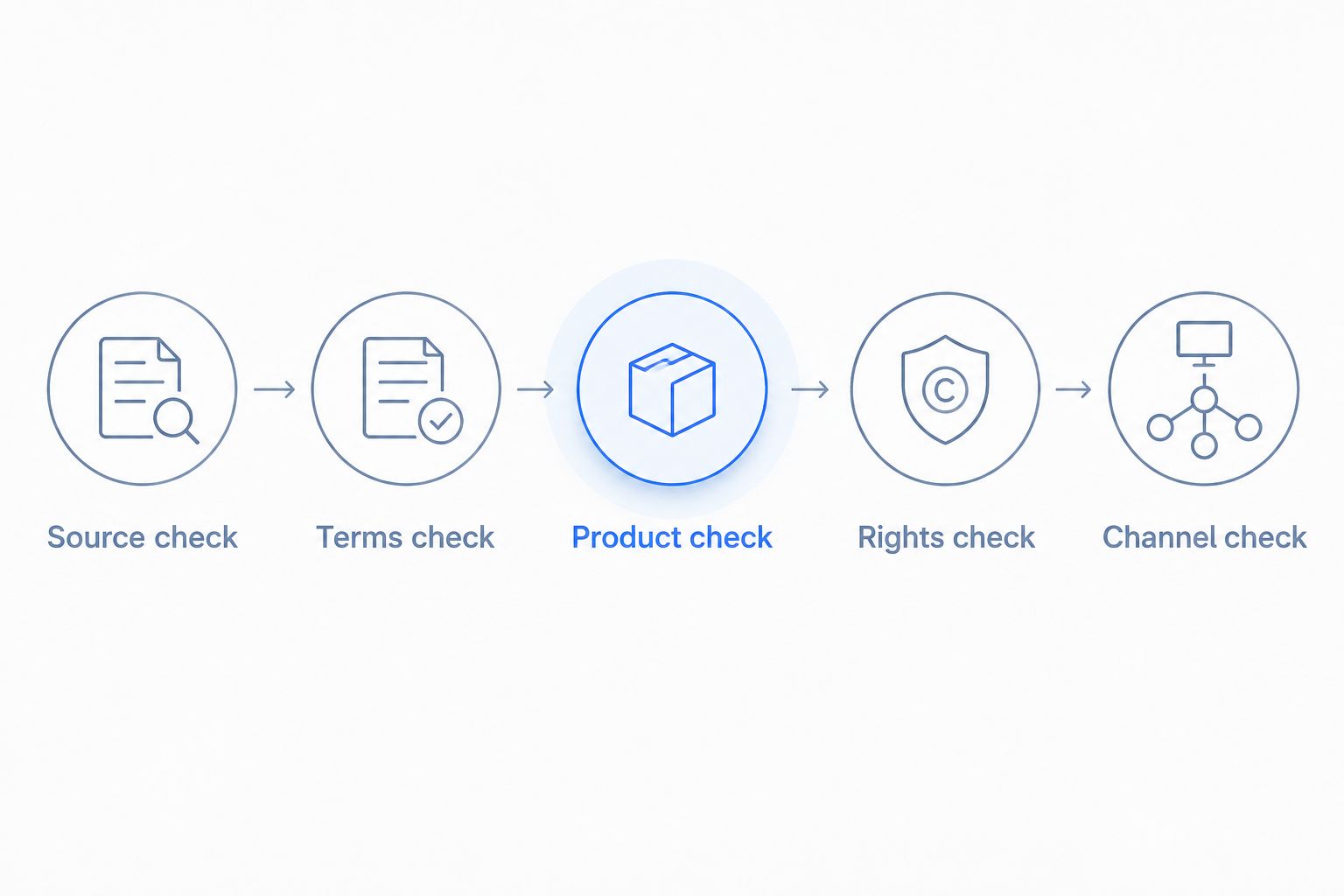
Keep the review attached to the final export, not just the original generation. An edit that adds a person, changes a label, or implies a new product benefit changes what needs approval.
FAQ
Is AI product photography legal for commercial use in the U.S.?
Yes, generated product photography can be used commercially when the use complies with applicable terms, rights, and advertising law. Commercial permission does not guarantee copyright protection or clear third-party rights.
Do I own the copyright if I write the prompt?
Writing a prompt does not by itself establish U.S. copyright in purely generated output. Human-authored edits or arrangements require a separate analysis.
Can I turn a supplier photo into an advertisement?
You need permission that covers the proposed use and modifications. A supplier relationship alone does not establish the scope of your image license.
Is a generated model safe to use in product advertising?
A generated model still needs review for recognizable likenesses and misleading endorsements. Do not portray a fictional model as a real customer who used your product.
Does an AI disclosure make an inaccurate product image acceptable?
A disclosure does not automatically cure a misleading product depiction. Correct material differences between the image and the product before publication.
Does Icarus clear all legal rights for my images?
Do not treat a creative feature as a legal clearance guarantee. Review the applicable agreement, your source permissions, and the finished image before publishing.
One last thing
Review the image without its caption. Ask what a buyer would believe about the product, included items, scale, performance, and endorsement from the picture alone.
Then compare those impressions with what you can substantiate. This catches a problem that a commercial-use license cannot solve: a permitted image that tells the wrong story about what you sell.